Game Hub

Brain Teasers

Was passt nicht - Kategorien-Logikspiel online

Finde das Ausreisser-Element schneller als alle anderen

Odd One Out presents players with a set of items - words, numbers, images, or concepts - and challenges them to identify the one that does not belong based on a shared category, property, or rule. The game trains categorical thinking, vocabulary knowledge, and the ability to identify distinguishing features across a group. It is widely used in language development programs, general knowledge sessions, and logical reasoning curricula. Odd One Out works across subjects - science, math, language, geography, history - making it one of the most versatile formats on MindLoop. The competitive multiplayer format adds urgency to what is naturally a reflective task.
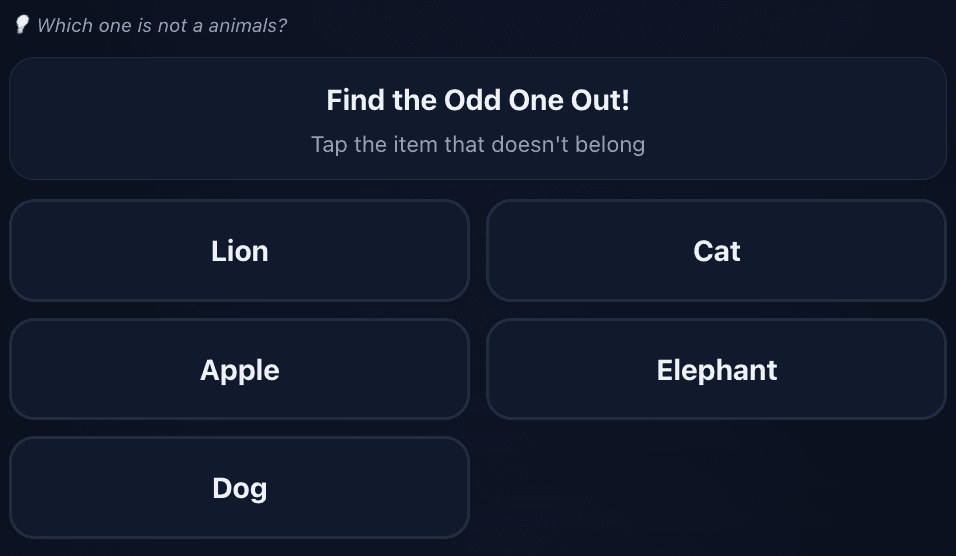
Odd One Out gameplay on MindLoop

How to Play

  1. 1

    A set of items appears on screen - words, numbers, or concepts

  2. 2

    Identify which item does not belong based on what the others share

  3. 3

    Select the odd one out and submit your answer

  4. 4

    Faster correct answers earn more points

  5. 5

    Items get more subtle and complex as rounds progress

  6. 6

    Leaderboard reflects both accuracy and speed

Who is it for?

  • Language and vocabulary teachers across age groups
  • Science and social studies teachers reinforcing classification
  • General knowledge quiz hosts and event organizers
  • Logical reasoning and critical thinking courses
  • ESL and language learning programs

Why Play?

  • Builds categorical thinking and classification skills
  • Works across all subjects - flexible for any curriculum
  • Language-accessible format suitable for diverse groups
  • Increases speed of concept recognition and recall
  • Fun and intuitive - almost everyone knows the format instantly

Frequently Asked Questions

Odd One Out can cover any subject - science, math, language, geography, history, and general knowledge. The host can select a category focus or use a mixed set.

Yes. Word-based Odd One Out sets are particularly effective for vocabulary development because they require understanding semantic categories and word meaning.

Yes. It is a popular format in ESL and language learning because it tests vocabulary knowledge without requiring complex sentence construction or grammar.

Difficulty scales from obvious groupings to subtle distinctions. Early rounds might group by color or shape; later rounds might involve conceptual categories that require deeper knowledge.

Yes. Rounds run in a couple of minutes, which makes it a good starter activity, form-time filler or brain break between lessons. It also works as a warm-up before a longer training session.

MindLoop is a free alternative that bundles classification rounds with question banks, assignments and long-term analytics in one place. Where Kahoot and Quizizz focus on one-off quiz rounds, MindLoop keeps a persistent workspace for your school, college batch or team, so progress carries across sessions instead of resetting every time.