Game Hub

Mathematics

Die Unbekannte finden - Gleichungsspiel fuer Schueler

Loese nach X schneller als alle anderen

Find the Unknown is an algebraic equation-solving game where players race to identify the missing variable in math equations. Each question presents an equation with one unknown - x, y, or another variable - and players must calculate and submit the correct value as quickly as possible. The game bridges the gap between arithmetic fluency and algebraic thinking, making it ideal for middle and high school students who are transitioning from basic math to algebra. Find the Unknown builds the equation-solving instinct through competitive repetition, reducing the anxiety that many students associate with algebra by reframing it as a game.
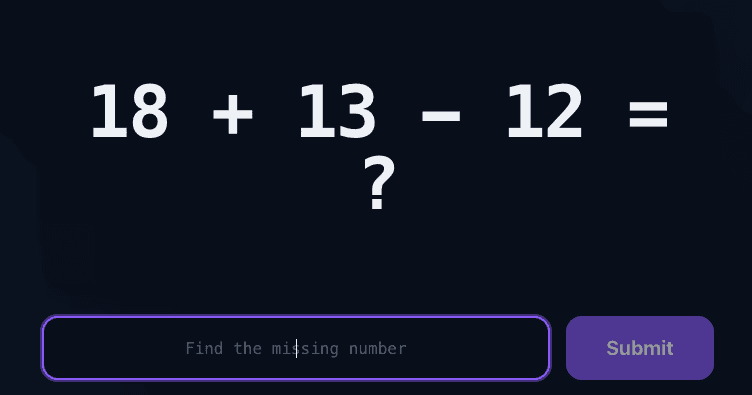
Find the Unknown gameplay on MindLoop

How to Play

  1. 1

    A math equation with one unknown variable appears on screen

  2. 2

    Solve for the missing value using mental math or quick calculation

  3. 3

    Type the answer and submit before time runs out

  4. 4

    Score is based on correct answers and response speed

  5. 5

    Multiple rounds cover different equation types and difficulties

  6. 6

    Leaderboard shows your rank compared to other players

Who is it for?

  • Middle school math teachers introducing algebra
  • High school students reinforcing equation-solving skills
  • Test prep courses covering pre-algebra and algebra
  • Students who find algebra stressful and benefit from a game format
  • Tutors drilling equation fundamentals

Why Play?

  • Builds algebraic intuition through repeated competitive practice
  • Reduces algebra anxiety by making equation solving feel like a game
  • Immediate answer feedback accelerates pattern recognition
  • Covers linear equations, basic expressions, and variable isolation
  • Competitive format makes repetitive practice feel engaging

Frequently Asked Questions

Find the Unknown covers linear equations with one variable - ranging from simple one-step equations to two-step problems. Difficulty increases across rounds.

Yes. The game starts with straightforward equations and increases in complexity, making it accessible for students just starting algebra and still useful for those reinforcing it.

By reframing equations as fast-paced competitive challenges rather than tests, students engage with equation solving repeatedly in a low-stakes environment, which builds confidence and fluency.

Yes. Regular practice in Find the Unknown directly improves the speed and accuracy of equation solving needed for algebra assessments and standardized tests.

Yes. Rounds are short enough to run as a starter activity or plenary in a primary or secondary maths lesson. Set the timer to two or three minutes, share the room code on the board, and pupils join from any device without an account.

It is built for exactly that. Timed arithmetic rounds give immediate feedback, so students build speed and confidence in mental maths through repetition. Teachers can run the same format for revision before a unit test or a board exam.

Yes. The speed-and-accuracy format mirrors the quantitative aptitude and reasoning sections used in campus placement tests and competitive exams, so it works as light daily practice alongside formal mock tests.

MindLoop is a free alternative that bundles algebra rounds with question banks, assignments and long-term analytics in one place. Where Kahoot and Quizizz focus on one-off quiz rounds, MindLoop keeps a persistent workspace for your school, college batch or team, so progress carries across sessions instead of resetting every time.