Game Hub

Visual

Desafio de cores Stroop - o teste cognitivo classico em multijogador

Leia a cor, nao a palavra

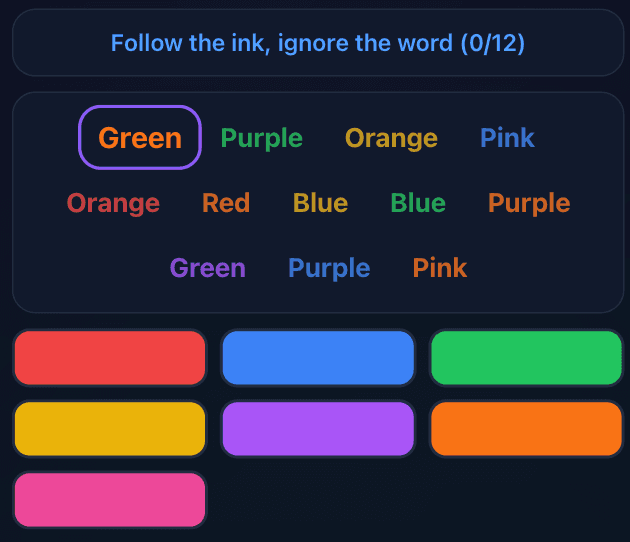
The Stroop Challenge is based on the famous Stroop Effect - a psychological phenomenon where reading a color word written in a conflicting ink color creates measurable cognitive interference. On MindLoop, this classic cognitive science experiment becomes a live multiplayer game. Players see color words printed in mismatched ink colors and must identify the ink color, not the written word, as fast as possible. It is one of the most effective tools for demonstrating selective attention and cognitive interference in classroom psychology discussions, and it doubles as a highly engaging competitive game. The Stroop Challenge is widely used in psychology classes, neuroscience courses, and as a novelty team event.

Stroop Challenge gameplay on MindLoop

How to Play

  1. 1

    A color word appears on screen printed in a different ink color

  2. 2

    Identify the ink color - not what the word says

  3. 3

    Select the correct ink color from the options shown

  4. 4

    Respond as quickly as possible for maximum score

  5. 5

    Conflicting colors are harder - stay focused

  6. 6

    Leaderboard tracks accuracy and speed across all rounds

Who is it for?

  • Psychology and neuroscience teachers demonstrating cognitive effects
  • Students learning about selective attention and cognitive load
  • Team events looking for an educational-meets-fun game
  • Research and training contexts exploring cognitive interference
  • Anyone curious about how their brain handles conflicting information

Why Play?

  • Based on real cognitive science - the Stroop Effect is well-documented
  • Educational and entertaining at the same time
  • Demonstrates selective attention in a tangible, felt way
  • Competitive multiplayer format adds stakes to the cognitive test
  • Great discussion starter for psychology and brain science topics

Frequently Asked Questions

The Stroop Effect is a psychological phenomenon where a person takes longer to name the ink color of a word when the word itself names a different color. It demonstrates cognitive interference between automatic and controlled processing.

Psychology and neuroscience teachers use the Stroop Challenge to demonstrate selective attention and cognitive interference live in class. Students experience the effect firsthand rather than just reading about it.

It starts manageable but the cognitive interference builds as rounds progress. The difficulty comes from the brain's instinct to read words automatically - overriding that instinct is the core challenge.

Yes. It is a popular icebreaker for events where you want something educational and slightly surprising. Most players are not expecting how hard it is before they try it.

Yes. Rounds run in a couple of minutes, which makes it a good starter activity, form-time filler or brain break between lessons. It also works as a warm-up before a longer training session.

Yes. It is a common pick for remote and hybrid team building activities, icebreakers before a workshop, and warm-ups at the start of an offsite. Everyone joins from their own device with a room code.

MindLoop is a free alternative that bundles attention and focus rounds with question banks, assignments and long-term analytics in one place. Where Kahoot and Quizizz focus on one-off quiz rounds, MindLoop keeps a persistent workspace for your school, college batch or team, so progress carries across sessions instead of resetting every time.