Game Hub

Visual

Stroop Color Challenge — The Classic Cognitive Test, Multiplayer

Read the color, not the word

The Stroop Challenge is based on the famous Stroop Effect — a psychological phenomenon where reading a color word written in a conflicting ink color creates measurable cognitive interference. On MindLoop, this classic cognitive science experiment becomes a live multiplayer game. Players see color words printed in mismatched ink colors and must identify the ink color, not the written word, as fast as possible. It is one of the most effective tools for demonstrating selective attention and cognitive interference in classroom psychology discussions, and it doubles as a highly engaging competitive game. The Stroop Challenge is widely used in psychology classes, neuroscience courses, and as a novelty team event.
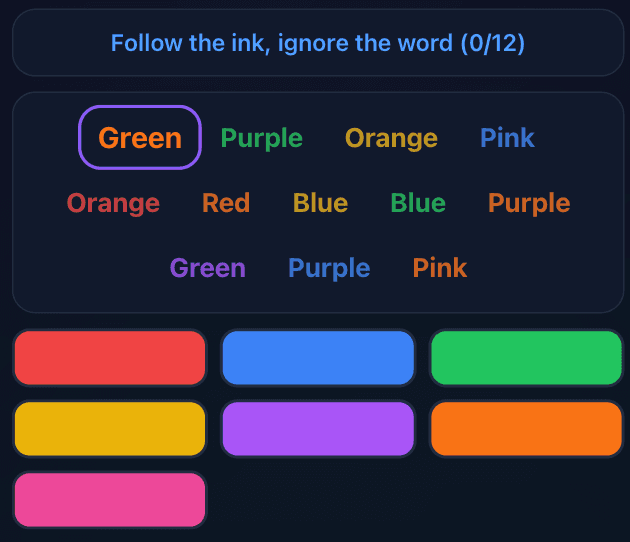
Stroop Challenge gameplay on MindLoop

How to Play

  1. 1

    A color word appears on screen printed in a different ink color

  2. 2

    Identify the ink color — not what the word says

  3. 3

    Select the correct ink color from the options shown

  4. 4

    Respond as quickly as possible for maximum score

  5. 5

    Conflicting colors are harder — stay focused

  6. 6

    Leaderboard tracks accuracy and speed across all rounds

Who is it for?

  • Psychology and neuroscience teachers demonstrating cognitive effects
  • Students learning about selective attention and cognitive load
  • Team events looking for an educational-meets-fun game
  • Research and training contexts exploring cognitive interference
  • Anyone curious about how their brain handles conflicting information

Why Play?

  • Based on real cognitive science — the Stroop Effect is well-documented
  • Educational and entertaining at the same time
  • Demonstrates selective attention in a tangible, felt way
  • Competitive multiplayer format adds stakes to the cognitive test
  • Great discussion starter for psychology and brain science topics

Frequently Asked Questions

The Stroop Effect is a psychological phenomenon where a person takes longer to name the ink color of a word when the word itself names a different color. It demonstrates cognitive interference between automatic and controlled processing.